
August 2026
A Field Guide to Growing
Community, buying built on trust, and advertising people want, for the largest audience in history.
Anuradha Sachdev built and led a fifty-person team that put agentic AI into production at enterprise scale by early 2024, including AI-powered customer support for NFL Sunday Ticket on YouTube.
In brief
YouTube has the largest audience in history. That reach makes three things possible next.
The first is tightly knit communities, which would change it from the place where everyone watches to the place where people are known. The second is more buying, built on the trust between a viewer and a creator. The third is advertising people want, and it arrives with the personal agent: fewer ads, each one wanted, priced on the sale rather than the view.
Not the length of the evening. The weave of it.
You measure a life in moments. Not the hours that fill the days, but the few that stay with you. A long dinner with friends that ran past midnight. A walk around the neighborhood with your partner. A Sunday afternoon with your kid at the local park. You were there, and someone was there with you, and it counted. You know the other kind too. The evening that disappeared into a screen. You were there for hours without being present.
The feed is not the villain here, and watching it is not weakness. My mother has a screen on for much of the day. World news in the morning. Then somebody teaching her a dish she has not cooked before, which she will cook that week, and which will be on the table the next time I visit. That is not an empty hour. Someone she will never meet taught her something, and we all get to enjoy it together as a family.
We are spending less time with each other every year. The most recent numbers say so. The feed promised to bring us closer. At scale it made the empty hour easy, but the good one is no easier to come by. More and more of our hours have drifted to a feed that reaches everyone and knows no one. Look at what people are reaching for instead. Run clubs and book clubs and group chats. Paying, again, for the newsletter written by one person they can know.
| People are looking for rooms faster than anyone is building them.
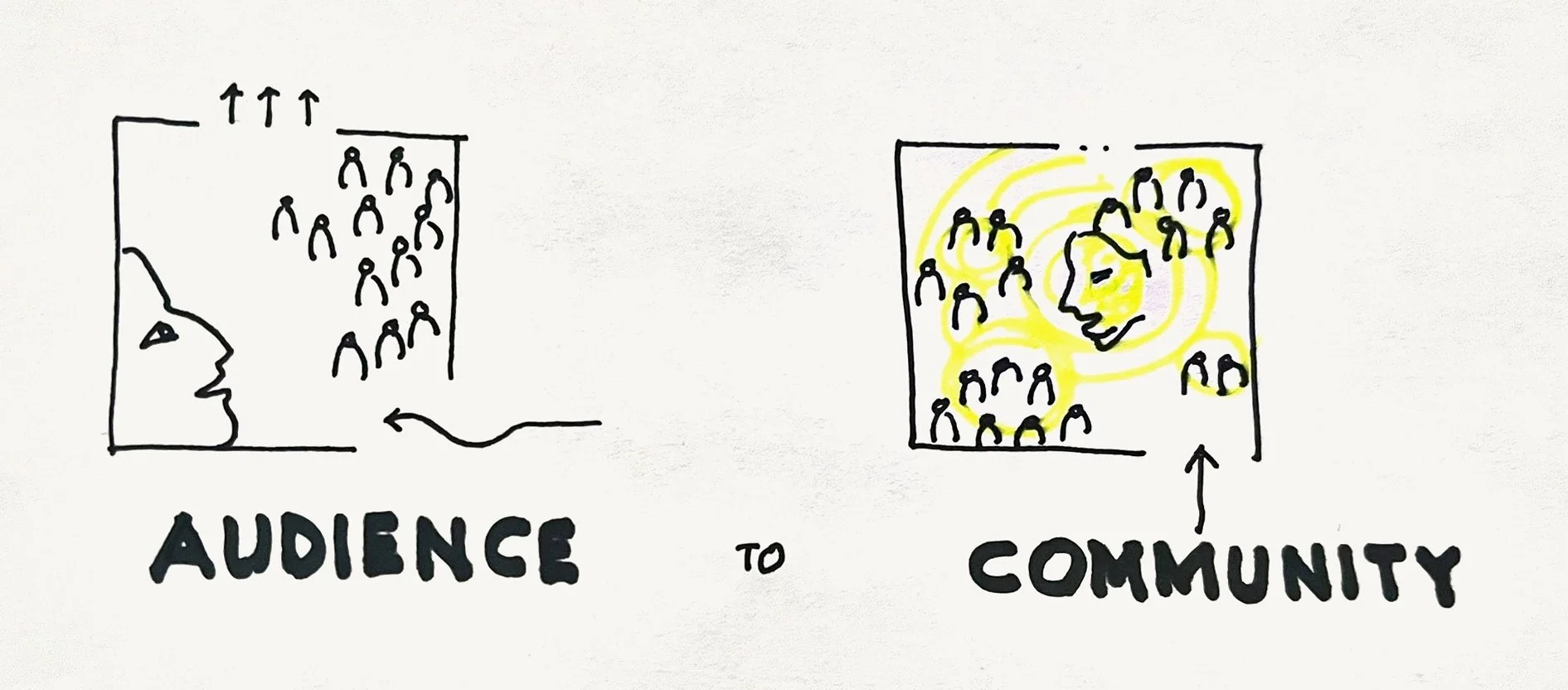
When audience becomes community
The platforms have mastered the audience: millions of people turned towards a creator on a stage, mostly strangers to each other. Each viewer is counted precisely, because attention is what the advertiser pays for. The platform knows everything a person has watched, but less about who they are.
| Being counted is not the same as being known.
The instinct is to manufacture community. Build the platform, add the features, run the campaign, and wait for community to appear. It never quite works. A community is not made; it is grown. A sociologist studying a deadly heat wave in Chicago found that two neighborhoods with the same poverty and the same heat had wildly different numbers of dead, and part of the difference was whether the streets gave people reasons to gather, so that they knew each other well enough to knock on a door.
A place becomes a community under three conditions. A center, a game or a cause or a craft to gather around, so a stranger has a reason to turn to the person beside them. A reason to come back, enough familiarity that a nod becomes trust. An edge, a clear line between inside and out. There is a door, and you have to open it. Without that line there is no inside, only a crowd.
The conditions are the start. What comes after is tending. When Flickr was new, its team of five or six posted fifty times a day, personally, modeling the kind of place they wanted, until the culture ran on its own. In livestream rooms it is the regulars who do that work, greeting newcomers by name and keeping the room a room.
Now run the three conditions against the platforms. Reddit and Discord are organized around the interest itself, and inside them people find real belonging. Twitch has the live room, where an empty seat is noticed, but only while the stream is on. YouTube has the opposite: more reach and better discovery than anyone, and almost none of the closeness. Each has half. The part no one has finished is both at once: tightly knit rooms, loosely coupled across the platform.
Most Sundays I watch a couple in Italy I have never met. They are the center, and the new video every Sunday is the reason to come back. There is no edge, and if I stopped they would not notice; a number would dip, and that is all. That is where most of YouTube already lives, one condition short of a room, as far as I can see from outside. The creators can feel it, because many of the ones I watch keep the wide audience on YouTube and take the smaller circle to Patreon or Substack, where their most loyal viewers pay to be closer.
| No engagement dashboard measures being missed.
What would an edge look like at YouTube's scale? A room needs a door, and it needs a size. Past about a hundred and fifty people the door stops meaning anything, and past a few thousand viewers a livestream chat is not a room. A city of ten million shows how this works. People do not live in the city; they live in a neighborhood, small enough to know their neighbors. You will never meet ten million people, and still you are a proud New Yorker.
The platform's job is the same as the city's: many small rooms, tightly knit inside and loosely coupled across the platform. Communities, where viewers post to each other instead of watching one stage, is the first move. The next could be a product that lets a room notice who has not come back. The measure of a room is not how many people are in it. It is whether the room would miss you if you were gone.
Buying built on trust
The second thing possible is more buying, built on trust. It depends on a person being known, and this time the person is the creator. The buying is already being built for; now YouTube lets creators tag Amazon products inside their videos.
A person buys in one of three ways. Sometimes I know what I need, say a new pan, and the work is finding the right one. That is when I may start at search, or a company website. Other times, I let someone I follow choose it for me. Four kids in my family, two sets of twins, stayed the night, and the deal was that they could pick dinner. They chose MrBeast Burgers, on a YouTuber's word. And then there are times when I end up buying something I did not even know I wanted. I saw a beautiful needlepoint cushion inside a home tour of a British designer, and could not stop thinking about it. This week I ordered it.
The last two kinds of purchases often start on YouTube because the people I can trust are there: the cooks, the reviewers, the makers whose judgment people rely on, millions of them, with years of public record. They have done the choosing, and I know who is talking. If they turn out to be wrong, I stop listening. A reviewer in a pool of reviews is a stranger passing through, but a creator's livelihood is built on people continuing to listen.
People have started to shop through AI assistants such as ChatGPT and Gemini. But an assistant cannot tell on its own whose judgment to trust. It needs a record, and YouTube has one: creators who have been right, or wrong, in front of everyone, for years. Where a person decides on what they remember, an assistant reads the whole record, and it cannot be charmed. That is why assistants will come to YouTube for discovery instead of going around it.
| When you know who is talking, you can choose whom to believe.
When the buying happens on the platform, the creator and YouTube earn from what sells, and the honest question is how commission shapes their recommendations. Two things hold it in check. The audience: the minute a recommendation does not work for me, I stop listening to that creator. And design: the platform chooses whether its recommendations stay neutral, or start favoring the products that pay.
Advertising people want
The third thing possible is advertising that people want. It takes a personal agent, one that works for you and not for a company. The agent knows what you are looking for, and when you want to be found, it says so. The advertiser reaches someone who wants what it sells, you see an ad you wanted, and the platform is paid for the match. That agent does not exist yet. The first versions are being built now, by Google among others, and I describe the one I want in The Theory of Moss.
Today the advertiser pays to be seen and the viewer pays in attention, wanted or not. The matching behind those ads is among the best in the world, yet it works from one side only. It infers what a person might want. A personal agent can supply the other side, saying when I am actually buying, or when something would save me money. An ad that arrives then is useful, with the purchase a click away. Fewer ads get shown, each one wanted, and more of them end in a sale.
| An ad that is wanted is worth more than one that is seen.
When the ad and the sale sit that close together, the price can follow the sale. More of the ads shown end in a sale, and the platform can be paid on those sales. Sierra, which builds customer-facing agents for companies, already prices this way, on outcomes agreed in advance: a sale made, a cancellation saved, a question answered. Paid on the sale, the platform wants what the viewer and the advertiser want.
The place where you are known
Put the three together, community, buying built on trust, and advertising people want, and you have a platform where being good to people and being good business are the same work.
This is not a new idea. Vanguard is owned by the people who invest in its funds, so every saving goes back to them as lower fees. It has cut them more than two thousand times since Jack Bogle set it up, and it is now the largest index fund manager in the world. Costco caps its markup, so when a supplier lowers its price the customer sees it on the shelf. Both were built to put the customer first, and that is why people trust them. YouTube has already done this, and it paid. The design team has removed billions of leave-behind ad units it could have kept, and engagement and revenue rose.
| A company grows by becoming a shape worth choosing.
YouTube has the largest audience in history. Reach was the last era, and it was won. Depth is the next one, and it is still open: to be the place where the most people on earth are known.
If you want to go deeper
The most recent numbers are the American Time Use Survey, which asks thousands of Americans each year how they spent the previous day. The hours spent with other people have been falling for two decades. https://www.bls.gov/tus/
Eric Klinenberg's Heat Wave is the Chicago study: two neighborhoods, the same poverty, the same heat, and very different numbers of dead. Mitchell Duneier went back and looked at who actually died in those neighborhoods. Many were people living alone, and a friendly street did not save them. His paper is worth reading alongside Klinenberg's. https://press.uchicago.edu/ucp/books/book/chicago/H/bo20809880.html · https://journals.sagepub.com/doi/10.1177/000312240607100408
Robin Dunbar is the anthropologist behind the hundred and fifty: the ceiling on how many people one person can really know. His short study asking whether social media raises that ceiling is worth twenty minutes, and the answer is mostly no. His critics quarrel over where the ceiling sits, not whether it exists. https://royalsocietypublishing.org/doi/10.1098/rsos.150292 · https://royalsocietypublishing.org/doi/10.1098/rsbl.2021.0158
Elinor Ostrom won the Nobel for showing that people can run a shared resource themselves, and keep it running for centuries, without an owner or a government in charge: irrigation courts in Spain, communal forests in Japan, pastures in the Alps, groundwater under Los Angeles. Her rules for why those lasted are worth the read, especially settling trouble while it is small and letting the people inside set the rules. https://www.cambridge.org/core/books/governing-the-commons/7AB7AE11BADA84409C34815CC288CD79
Researchers once sat in livestream rooms and watched the regulars do the work of hosts, greeting newcomers by name and keeping the room a room, until past a few thousand viewers it broke into a waterfall of text. Streaming on Twitch, by William Hamilton, John Garretson and Andruid Kerne, is twelve years old and still the clearest account I have found of what a live room does. https://ecologylab.net/research/publications/streamingOnTwitch.pdf
People who arrive at a store through an AI assistant buy at close to fifty percent higher rates than people who arrive through search. Shopify's report has the numbers, and their own reading, that this grows on top of search rather than replacing it, is the honest one. https://www.shopify.com/enterprise/blog/ai-search-insights
YouTube's own numbers: seventy billion dollars paid to creators, media companies and music partners over three years, and, as of August 2026, Amazon products taggable inside Shorts, videos and livestreams for eligible US creators. https://blog.youtube/news-and-events/youtube-shopping-amazon-creator-affiliates/
Universal Cart is Google's own shopping agent, announced in May 2026: one cart that works while you search, talk to Gemini, watch YouTube or read Gmail. It is the first version of the thing this essay is waiting for, built by the company that owns YouTube. https://blog.google/products-and-platforms/products/shopping/google-shopping-cart/
Sierra builds customer-facing AI agents for companies, and it charges on outcomes agreed in advance, a sale made, a cancellation saved, a question answered, and in most cases not otherwise. Their short post on outcome-based pricing says it in a page. https://sierra.ai/blog/outcome-based-pricing-for-ai-agents
A fund company owned by its own funds has no one else to earn for. More than two thousand fee cuts since 1975 later, nobody can compete with what it hands back. Vanguard Is the Costco of Finance, by the hosts of Acquired in the Wall Street Journal, is the best account I have found of a company built so that it cannot help putting the customer first. https://www.wsj.com/finance/vanguard-costco-acquired-podcast-hosts-bogle-96d97c7d
YouTube's design team has removed billions of small ad units, and engagement and revenue rose. Fast Company's article on the redesign, from this summer, is a rare look inside design decisions at that scale. https://www.fastcompany.com/91580299/youtube-is-on-a-major-decluttering-mission
Mark Curtis asked himself how many brands he truly loves, made the honest list, and it stopped at seven. Customer Love is Rarer Than You Think finds the same ceiling in our relationships with companies that this essay finds in rooms, and he shows his working the whole way. https://www.wearefullmoon.com/customer-love-is-rarer-than-you-think/
The personal agent comes from The Theory of Moss, which looks at a company through the eyes of the person it serves. This essay turns the same question on a platform: what would YouTube look like to a viewer whose agent answered only to them? Worth reading for how it ends. https://www.anuradhasachdev.com/the-theory-of-moss
Waste Time Magnificently is the same question asked about a neighborhood instead of a platform: where community comes from, and why showing up has to be easier than staying home. It is where I found my own room, a Thursday yoga class. https://www.anuradhasachdev.com/waste-time-magnificently
Anuradha Sachdev has spent her career redesigning how companies serve people through technological shifts — early digital, then mobile, now AI. Most recently she built and led the fifty-person practice at Accenture Song that put agentic AI into production by early 2024. She now works with companies, advising leadership teams, mapping what's actually happening and what to build next, and leading the product build through launch and adoption. She writes about what the work reveals.
Send a note →