
June 2026
Which companies survive the age of the personal agent, and which will quietly disappear.
Anuradha Sachdev built and led a fifty-person practice putting agentic AI into production at enterprise scale. This is what that work revealed.
The Theory of Moss
IN BRIEF
Everyone is about to have a personal agent. The one that answers to you reads what a company actually did, not the story it tells. It cannot be charmed.
Some of a company's revenue comes from customers who chose it. The rest is inertia revenue™: customers who stay out of habit and would not choose it again. The personal agent tells the two apart.
The thousands no one had counted
I have spent years in the rooms where companies decide how to treat the people they serve. In one of them, I saw something counted that I have not stopped thinking about.
We were working to bring four systems together — insurance, care, pharmacy, wellness — so a person would not have to navigate each of them separately. I asked a simple question: how many messages does a patient get?
The answer came back as a spreadsheet in the thousands.
Some of it was genuinely useful. The rest had accumulated over time, each piece added in good faith, until the whole became noise. What a person is waiting to hear is a short list. An appointment confirmed. A prescription ready. Test results. A claim approved or denied. Something that has changed or needs a decision.
| Nobody had been asked to look at the whole picture. So nobody had.
This was healthcare. And even here, the system was asking for a person's time and attention thousands of times over, without ever seeing what noise it created.
The price of being served
Time and attention are the scarcest resource a person has. Every company that touches a person's life is making decisions about them, and most are built around their own efficiency, not the person on the other end. Companies measure what they are accountable for: revenue, cost, retention. What they rarely measure is what the same interaction costs the person.
| A denied claim is a resolved transaction for the company. For the person who filed it, the work is just beginning.
The two views of the same interaction produce entirely different conclusions about whether it is working. How a company treats a person's time and attention is how a person reads whether it values them: how it directs their time, how it directs their attention, how it removes what does not need them. That is how trust is earned or eroded.
Trust built that way is a living thing. It grows where the conditions are real, and nowhere else.
The person’s turn to see
For most of history, the company had the data, the record, the read on what worked for it. The person on the other side had nothing like it, and the cost of comparing, switching, or leaving was high enough that they often stayed where they were.
That is what changes now.
The personal agent most people describe is built for efficiency: tasks done, transactions closed. It books a table, completes a purchase, makes an appointment. That is real, and it is the smaller part. The personal agent I would build to represent me does more. It has reach: it does what a person cannot, and what they would rather not do themselves. It applies a person's judgment: what to handle, what can wait, what they never need to see. And it provides foresight: thinking ahead the way a person rarely can in the thick of life.
The personal agent is the person's own. What it knows stays private, and surfaces only when the person chooses. It is the optimizer a person never has the time to be.
That kind of help used to belong to the few. Now anyone can have it.
None of this is settled. The first personal agents to reach everyone will come from companies with something else to sell: they will help the person, and carry the company's interests too. That will be useful. But whoever pays for a personal agent gets to decide whose interests it weighs. This piece is about the personal agent that answers to the person. That is the one your company should expect to meet. Even if only half of what is described gets built, the person can see what they never could.
| The personal agent is loyal to what the person values, not to any company.
There are two things no company can hide from. The person's own history: the personal agent is there for every interaction it handles — what was promised, what arrived, what it cost to get. And the market itself. Every company is compared to every other. No person could see both, but the personal agent can. It reads what a company actually did, not the story it tells.
My grandmother had a line for it. Handsome is as handsome does.
Every company has a shape
The personal agent reads the whole record: what was promised, what arrived, what it cost. Read that way, every company has a shape.
Companies have always worked to see themselves as their customers do. The data was there, more of it every year, more of it close to real time. It was never enough. A company can measure an experience, but it cannot have the experience. The person has the experience — a thousand small moments, spread across years — but no one keeps count of their own life in that detail. The personal agent does. It is there as each moment happens, and it does not forget. For the first time, the person can see the company completely.
The company always got to tell its own story. Now the person who lived the relationship holds the verdict.
The customer's personal agent is built to see your company whole. It makes visible what was already there: the value a company creates, the work it imposes, and the trust it earns or erodes.
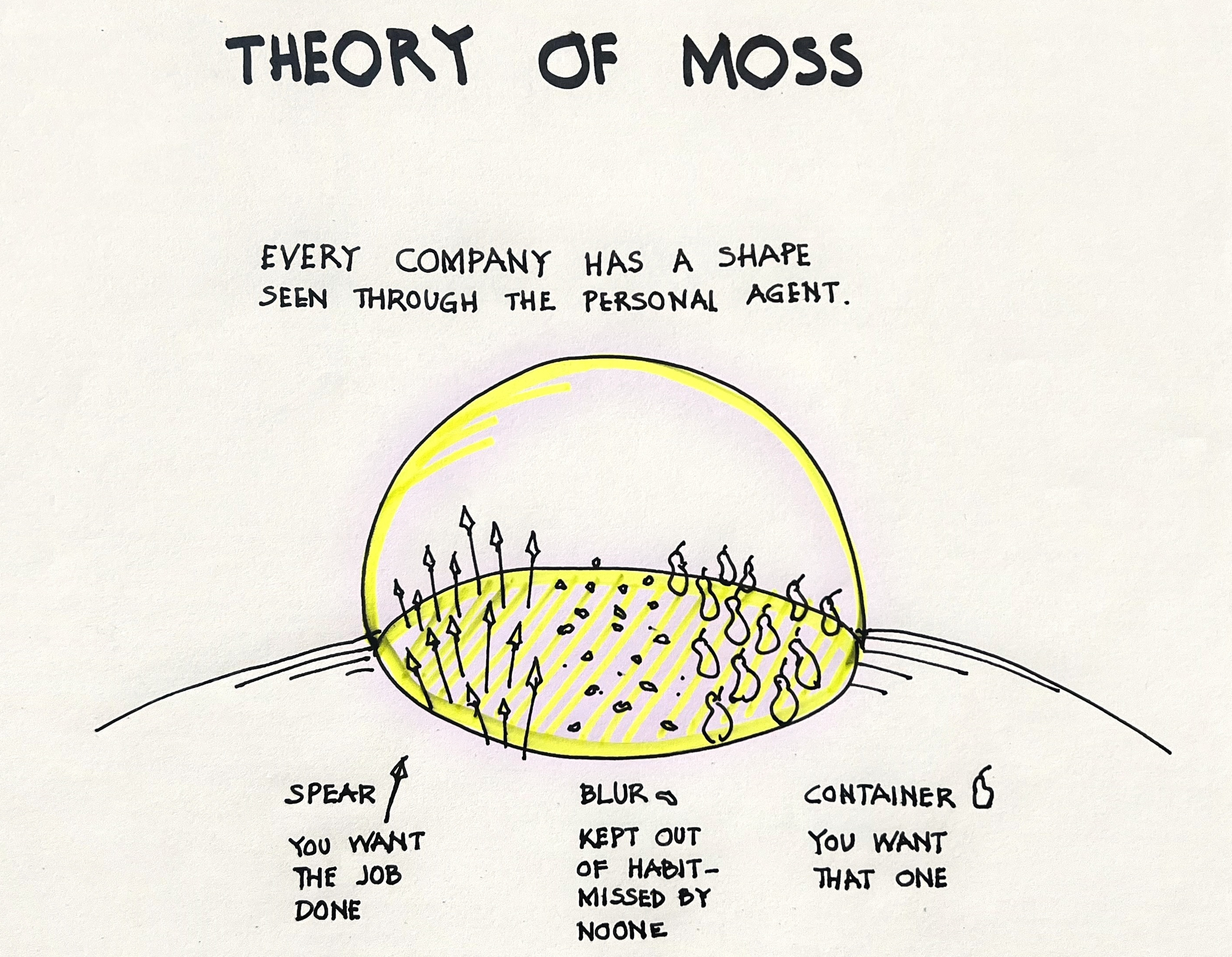
Seen this way, every company has a shape.
| There are three shapes: the spear, the container, and the blur.
With a spear, a person wants the job done. Any spear that does it will do. With a container, they want that one. No other will do. A person needs both.
A person orders from Amazon and doesn't think twice. It built its business on three promises: selection, price, convenience, and it keeps them, order after order. That makes it a spear: it does one thing they need, dependably, so people can hand the task to a personal agent. Prime makes leaving harder. Take it away and the order still goes to Amazon, because the three promises are kept. The personal agent does not threaten the spear. It becomes its best customer.
Apple costs more than its competitors by most measures, more still in India, and people choose it anyway. They have stopped comparing. That is a container: the one a person stays with even when something cheaper or better exists — held by how they feel about it, for reasons that are their own, and not always rational. They forgive it when it slips, up to a point. The personal agent can put every cheaper, better option in front of them; it changes nothing. The choice was never made on those terms. The person does not ask for a phone. They ask for the new iPhone. The personal agent does not threaten the container. The person has already chosen.
Between them is a third place. Call it the blur. It is where a spear or a container ends up when it stops being either: the spear no longer the best at the job, the container no longer the one a person would choose again. What is left is kept out of habit, not want. It held its place because looking again took more effort than it was worth.
A spear is missed when it goes, because the job stops getting done. A container is missed even when it is replaced, because the person wanted that one. The blur is missed by no one. Its absence leaves no gap.
Shape is a relationship
Until now we have looked from the person's side: what a company costs them, what it asks of their time, whether it earns their trust. Now look at the company itself, and every one takes a shape. A shape is not a category a company sits in. It is closer to a mindset in a person: nobody is a mindset — they are in one, for now, and they move. A company is read as a shape the same way: with this person, for this need, for now.
A bank, at its simplest, is a spear: it holds the money, moves it when asked, keeps it safe. It becomes a container when it takes an active part in a person's life, in helping them plan for a future they want and cannot yet reach. The same bank can be both, and which one it has been to a person is now plain to see.
A doctor trusted for years and a handbag chosen are both containers, and they look nothing alike: one held for judgment built over time, the other for reasons that are the person's own. A hospital and a fashion house can hold the same shape.
A ride-hailing platform is a spear to the rider: dependable, there when needed, a way from one place to another. To the driver who has built a living on it, the same platform is a container.
A government office is not one shape. Renewing a license is a spear. Being carried through a crisis is a container, the trust deepening with each step. The same office runs both, and its failure is treating them the same. There is no other office to choose, and that is what kept this hidden. The shape was always there to read.
| A company does not choose its shape. It is given one, by the person it serves.
Growth is a change of shape
A company grows by becoming a shape worth choosing.
An ad-funded platform is a spear, paid for by the advertiser. The advertiser pays to be seen, but the person pays in attention, and not always for what they need. The personal agent knows exactly what the person wants, and shares it only when the person chooses to be found. The advertiser reaches the person who wants what it offers, and no one else. What looks like a threat is better business: making the connection both sides want. There will be fewer ads, each one wanted. The noise was revenue.
A power company is a spear to the household: keep the service reliable, the bill accurate, the help real when something goes wrong. For the household, that is enough. For the small business, where energy costs come out of the profit, the same spear is a missed chance. In every project I have been part of, the small business falls through the gap. The owner gets what a household gets. A portal. A bill. A number to call when the power goes out. Everything on offer helps her spend less. That is real, and it is where it stops. It could be a container: taking an active part in the business, helping her reach a future she wants and cannot yet reach. The move already exists: UPS took the network it ran and put its rates inside the software small sellers already use, giving the small shipper terms that only the largest accounts used to get. A utility can do the same beyond the meter.
| A spear grows by being better at the job. A container grows by being trusted with more.
The same is true when the customer is a company. The product or service has to work well. When the offerings start to look alike, the vote goes to the company that knows the systems, stays for the integration, helps make the customer successful. That kind of partnership was always rationed, reserved for the largest accounts — it took people, and there were never enough. Now it can reach far more of them. The buyer always tried to read that record before signing; the buyer's agent reads it whole.
Reading your own shape
The customer's personal agent reads your company too.
Your company already fields agents of its own. There are more of them today than on the person's side, and they are further along. Soon they will deal with the person's agent, not the person. A person decides on memory — the last thing that happened, the thing not yet forgotten. The person's agent decides on the whole record. It reads you again at every interaction, not once, and it will be harder to fool.
Did your customers look at anyone else before they stayed? The ones who looked and stayed chose you. The ones who never looked have not chosen anything yet, and their agent will do the looking they never did. Call that inertia revenue. Some of that revenue is walled in: a contract, a switching cost, a rule that leaves no way out. A wall can hold for a while. No board should mistake it for choice.
| Some of your revenue is chosen. The rest is inertia revenue™.
If the personal agent reads you as a spear, are you still the best at the thing the customer needs? The order goes to whoever serves the need best. Not who served it best last time. A name you spent years building counts for less than it did, because the record is what gets read. A company no longer has to be the biggest to be chosen. It has to be real.
If it reads you as a container, is the trust real, or is it friction you have mistaken for loyalty? And do you know what people actually trust you for? Newspapers defended print; they were trusted for the news.
If it reads you as a blur, you will be the last to know. From the inside, for now, the revenue arrives and the customers renew. All of it is inertia revenue. Nobody looked, so nobody chose you.
No shape lasts. You have to earn it again, every time.
The theory of moss
In 1955 Fortune published its first list of the top five hundred American companies by revenue. By 2021, about one in ten of those were still on it. Companies rarely die at once. They are chosen less and less, until they are not chosen at all. Not as punishment. As selection.
The personal agent did not start this. It only makes it impossible to ignore. Some customers stay because they want to. Some stay because leaving is hard. That was always true. The personal agent lets you tell them apart. If, ten years from now, the blur still holds where a person is free to leave and their agent does the choosing, this theory is wrong.
There is a plant that has lived this way for four hundred million years. Moss never grew true roots. It lives on what reaches its surface, green when the conditions are real, brown when they are not. It cannot pretend, and it cannot hide. It cannot live on yesterday's rain.
| Moss is exactly as alive as its conditions allow. So is a company.
A company lives the same way, on its surface, in every interaction it has. What it earned last season does not water it this one. It is real now, in this interaction, or it is not. A real spear stays green. A real container stays green. The blur is the brown: the company that is neither, and has dried out.
The brown is not dead. Moss can wait, brown and still, for years. But waiting does not make it green — only real rain does. A company in the blur can wait too. Waiting is not the way back; becoming a real spear or a real container is.
Microsoft went brown, and stayed brown for years, kept alive by the licence and the habit. Under Satya Nadella it became real again: something people rely on, something companies trust. Green for now, which is the only kind of green there is.
This is the theory of moss. What is real will survive.
If you want to go deeper
The words spear and container are Ursula K. Le Guin's, from The Carrier Bag Theory of Fiction. She set the container above the spear — the bag, the vessel, the thing that holds, against the weapon and the thrust. This piece makes them equals, which is a departure from her. Her essay is short, and worth reading on its own terms; she is arguing about how we tell stories, and it turns out to be about much more. It is collected in Dancing at the Edge of the World, and Ignota published it on its own in 2019. ursulakleguin.com/the-carrier-bag-theory-of-fiction
The idea that a company can become legible to itself is the subject of Jack Dorsey and Roelof Botha's From Hierarchy to Intelligence. Much of the discussion around the piece focused on what it might mean for management and organizational structure. What stayed with me was a different question: what becomes possible when a company can see itself clearly? This piece asks a similar question from the other side: what becomes visible when a person can see the company just as clearly? sequoiacap.com/article/from-hierarchy-to-intelligence
The first draft of this piece was written in the spring of 2026, before the research arrived. Since then the measurements have come in. Accenture found more than a third of loyal customers would let their personal agent switch brands for a better fit. Deloitte put a quarter of global e-commerce in agents' hands by 2030, and found nearly two-thirds of retailers already believe a company without agents falls behind inside two years. BCG mapped which industries are most exposed, and found the safest hold real trust or a regulatory moat — the most exposed had high disruption risk and little holding the customer at all. Bain found AI already driving up to a quarter of referral traffic for some retailers, while still under one percent of all traffic. The ground is moving the way the theory said it would. accenture.com/us-en/insights/consulting/talk-my-ai-agent | deloitte.com/us/en/industries/consumer/articles/agentic-commerce-ai-shopping-agents-guide.html | bcg.com/publications/2026/introducing-the-consumer-ai-disruption-index | bain.com/insights/agentic-ai-in-retail-how-autonomous-shopping-redefining-customer-journey
Inertia revenue is my name for it, and it has been measured. Economists writing in the American Economic Review studied ten subscription services and found that if everyone had been paying attention, the sellers would have earned about half as much. web.stanford.edu/~leinav/pubs/AER2025.pdf
Who is building the first personal agents, as of this writing: an ad business — Google, and Meta behind it; a store — Amazon; a device maker — Apple; and OpenAI, which is still deciding what it is — checkout fees first, advertising now. None of them is paid by the person to represent the person. Whether one ever will be is the open question. Doot, below, is one answer.
Doot is a proposed agent for every Indian citizen, built on the public rails of Aadhaar, DigiLocker, and UPI — owned by the person, not the platform. It is given hands and a voice: it can discover, verify, and transact, in a person's own language. A reminder that whose the agent is may matter as much as what it can do. digidoot.in
My first paid project was at the Getty Conservation Institute, building a digital record of where the hominids walked at Laetoli. The footprints are 3.6 million years old, a record of what was actually done, preserved so it could be read long afterwards. I have been working on that same idea ever since, without knowing it. https://www.getty.edu/projects/hominid-trackway-laetoli/
And if you want to see moss, you do not need a citation. Find it on a wall or a stone after rain, and again in a dry spell — it is doing, on its surface, exactly what this whole piece is about. I first saw it whole twenty-five years ago, on the hill above Guimarães in northern Portugal: a funicular up to a church, and around it a forest where everything — the trunks, the stones, the ground — was covered in moss. Long before I had a theory for it, I had the image. I have never forgotten it.
I built and led the North America customer service experience practice at Accenture Song — fifty people designing and deploying agentic AI at enterprise scale. I came to this work through architecture and computation, which shaped how I think about systems: why organizations struggle to adapt, where trust is won or lost, and what it takes to make technology work in the real world. If that's the part you're building, I want to hear about it.
Email →