
June 2026
Waste Time Magnificently
We no longer have a date to experience anything together, unless it's sports. The rooms already exist; what needs to be built is a system the neighborhood can run to bring people together.
Anuradha Sachdev trained as an architect and runs AI-driven transformation end to end, from strategy to deployed product to adoption. She built and led the fifty-person practice at Accenture Song that put agentic AI into production by early 2024.
The constraint created a commons
Growing up in India before satellite television, I watched the same handful of shows as everybody else. Wednesday night was Chitrahaar — film songs, back to back, for an hour, on Doordarshan, the one channel. Sunday was a Hindi film — one film, the same film, watched by everyone with a television at the same hour. You couldn't time-shift any of it. You couldn't opt out and find something better. On Monday morning you could talk to anyone about the Sunday film because there was no other Sunday film.
My parents lived in a mining town, far from any city, the kind of place that had one of everything. One club. One day when everyone went. No one had chosen who they would find there. Showing up was simply what you did.
Nobody designed the community. It was a byproduct of having nowhere else to be.
That condition sounds like deprivation from the outside. From the inside it produced something we spend enormous effort trying to recreate now: a commons. The same people kept the same rhythm, and kept meeting each other inside it.
Sports is the last mass occasion. It happens at a specific time, everyone watches at once, and everyone talks about it the next morning. That's why sports has become so culturally dominant even as many of the other occasions where everyone gathered together have gone.
| The commons didn't get destroyed. It got personalized out of existence.
Infinite choice arrived and the shared Wednesday disappeared inside it. When everything is available always, nothing creates an occasion. When the experience is optimized for you alone, there's little you share with others.
The dog decides. You just put on your shoes.
I have a version of myself that only appears when I travel. Curious. Open. Willing to walk miles to a place I've never heard of, take a detour, get lost, spend an hour talking to a stranger. That's the person who is fully alive.
When someone visits me, I go to the places I've been meaning to go for years. I finally eat at that restaurant everyone has been talking about. I walk streets I would normally drive. For these days I hold two things at once — the knowledge of a resident and the attention of a visitor. Then the guest leaves and I stop.
A local place with a calendar can often play the same role as a guest. For me it's the Huntington Gardens, because something specific is happening there that won't be there next week. The corpse flower in bloom. The fall plant sale. Live music in the gardens. Something that does what Chitrahaar did: it creates an occasion. For someone else, it may be the Saturday morning walk in the neighborhood with a friend, or the ritual of going to the local farmers market every Sunday.
People with children engage more with their neighborhoods, and so do people with dogs, because their lives have contact built in. The school pickup line. The dog park at seven AM. The other parents at the Saturday game. Nobody chooses those interactions the way you choose a restaurant. They happen whether or not anyone is in the mood.
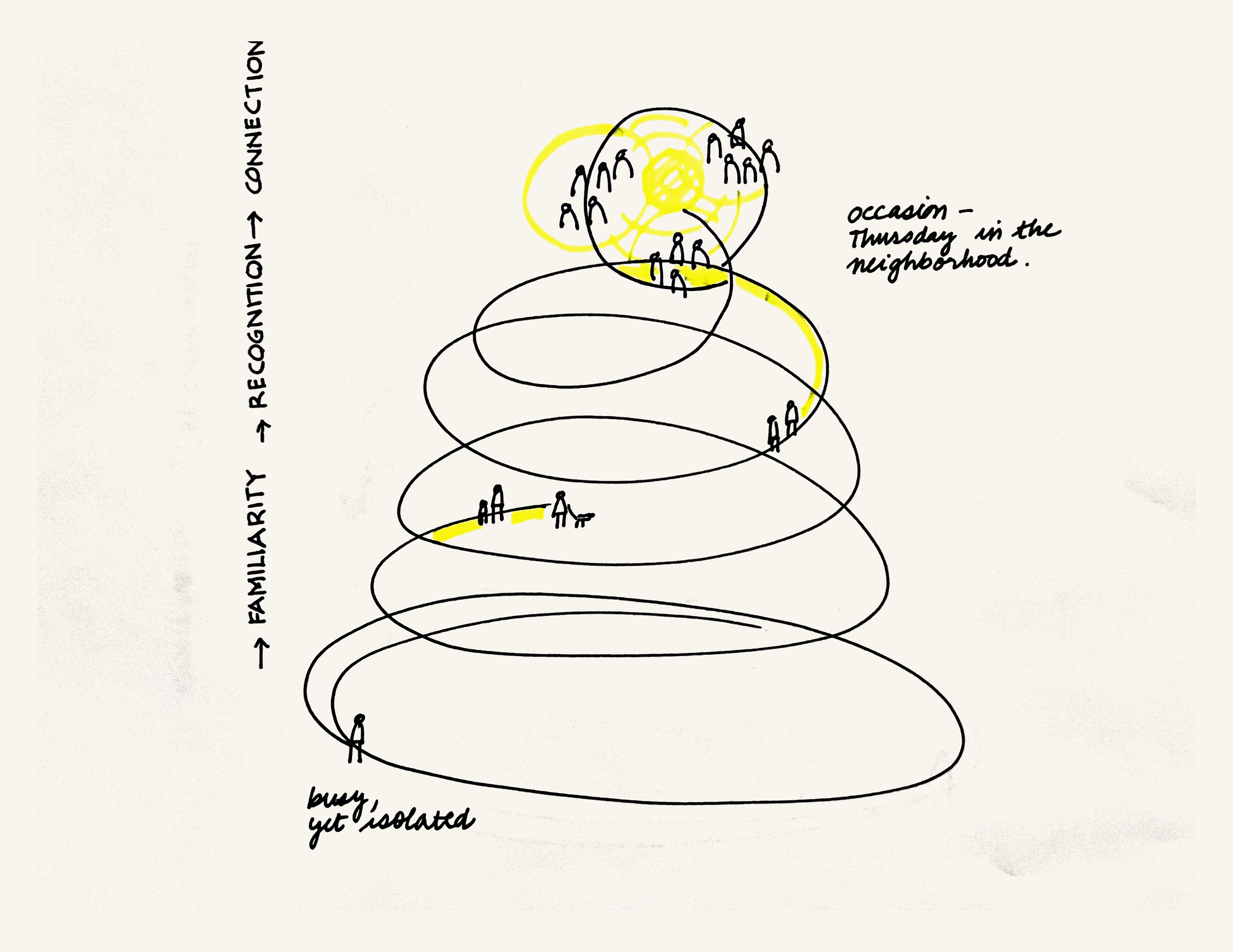
And out of that non-optional contact, something grows. Familiarity. Then recognition. Then, sometimes, actual connection. Because the structure puts people together, repeatedly.
Over six months at the dog park, you get to know the people's names, their dogs' names, something about their lives. The person with no children and no dog has to build all of that from scratch. Every time.
| Nobody is expecting the single person anywhere, so most days the couch wins.
Evidence that you belong
A friend invited me to join her for the farmers market in her neighborhood. In the space of that hour, she ran into three neighbors. Three separate conversations, each one unscheduled, each one a quick minute or two. Evidence that she belongs: she knows the place, the place knows her, and the market is where it shows.
| Being in the same place at the same hour, week after week, is enough to turn strangers into people who know you.
When I first came to America for school, I lived in LA for years. Eventually I thought: I've only ever lived here. I wanted to try another city, a walkable one. So I moved to San Francisco.
It was hard. Genuinely, persistently hard. SF is exactly the city that should have worked. Dense, walkable, full of people. I tried for three years. But I had none of the built-in structures: no dog, no child, nothing outside of work that put me in the same place with the same people. The city was alive around me yet I was outside it.
My mother, who is wise, suggested I move back to my old place in LA. I did. My friends here are family.
On a work trip back to SF, someone at the airport looked vaguely familiar. She came over to say hello. We had gone to the same farmers market, she reminded me. That was the whole relationship. The same Saturday morning, the same stalls. She didn't have my number. But she knew my face, and she was warm, and that warmth — from someone I had never really known — was what three years of visiting the Fort Mason farmers market had produced.
The neighborhood runs the room
In 1961, theater director Joan Littlewood and architect Cedric Price proposed a building on the Thames with no fixed program — moveable walls, adjustable floors, a cybernetic system that would respond to what people needed. They called it the Fun Palace, a university of the streets. It was never built.
The technology Price imagined was the wrong answer to the right question. He thought the responsiveness had to live in the building. What he was looking for was simpler and more durable: the same thing, in the same room, at the same time, until the neighborhood counts on it. The Tuesday music practice. The Thursday tambola. The monthly seed swap.
The recurring program makes showing up easy. Over time it becomes what this neighborhood does.
The most alive spaces I've seen are where the locals meet up, regularly. A school gym on Saturday mornings where the same guys have played basketball for years. The high school parking lot that hosts the weekly farmers market. The library, the market, the piazza invite you to be a person among persons, a citizen rather than a consumer.
Almost every neighborhood has a school gymnasium locked by 6 p.m., a public library with meeting rooms that see two bookings a week, a church hall dark six days out of seven. The physical footprint exists. The civic investment already happened. What's missing is for people to work out how these rooms can be run for the community.
For a gym to open every Thursday, a neighborhood needs all of this: rules the people who use the room make and keep themselves, a rota so the work is shared, one agreement with whoever owns the building, insurance carried once for everyone, and a count of who came. Take one away and the room stays locked.
| The room is ours to run, and what happens in it is ours to make.
parkrun has all of it. It began in 2004 as a free 5k in one London park, every Saturday at nine, with thirteen runners. It is now 2,300 events a week in twenty countries, each run by local volunteers on a rota, on one agreement per park, with insurance carried once by a central charity and a barcode scan for every finisher so the count is public. It has never paid for a venue.
The city that figures this out doesn't need new civic buildings. It needs the decision to keep the gymnasium two blocks from where you live open and warm every Thursday night for tambola.
This is what cities are for.
Magnificent Waste
Price called the Fun Palace a place where you could waste time magnificently. Not leisure, which implies recovery. Not entertainment, which implies consumption. Magnificent waste. Time that justifies itself by the quality of being alive in it.
The mining town club. Chitrahaar on Wednesday nights. My friend's local farmers market. The SF farmers market that turned into a warm hello at an airport. None of them were designed for belonging. All of them produced it, as a byproduct of simply being there, reliably, at the same time, with whoever else showed up.
| The Wednesday was given to us. The Thursday is the one we make.
Price and Littlewood did not get their building. But their idea lives on as an event, started in 2014. Every year, on the first weekend of October, communities across Britain take over whatever place they have, a library, a town square, a boat off the coast of Cornwall, and run it themselves, free, under the name Fun Palaces. The events are the kind that bring neighbors together: a sewing circle, a language exchange, a games night, a choir, a shared meal. The program is set by the people who live there, for whoever walks through the door.
Fun Palaces runs one weekend a year. What I am describing is a Fun Palace every Thursday. The door just has to be open. On a Thursday. Every Thursday. Until the neighborhood expects it.
We have the buildings. What we need is the Thursday.
If you want to go deeper
Cedric Price's drawings for the Fun Palace survive — worth seeing what a building that refused to decide what it was looks like on paper. His question is the one this essay tries to answer: "Technology is the answer. But what was the question?" https://www.moma.org/artists/7986-cedric-price
Fun Palaces is the campaign that took Price and Littlewood's name out of the drawings and into libraries and town squares, one weekend every October since 2014, run by whoever lives there. I found out about the campaign only after this essay was written. https://funpalaces.co.uk
Elinor Ostrom won the Nobel in economics for showing that people who share a resource can set their own rules and run it themselves. This is her saying it in under five minutes, a few days after she got the prize. The book behind it is Governing the Commons. https://www.youtube.com/watch?v=Qr5Q3VvpI7w
99% Invisible made an episode with Eric Klinenberg about social infrastructure — why libraries, gyms, and courtyards are as real as roads and power lines, and what happens when we fund them like decoration. https://99percentinvisible.org/episode/palaces-for-the-people/
There is a film of Alain de Botton's The Architecture of Happiness — his argument, made walking through real homes, that buildings speak to us about who we could be. I have found it to be literally true. https://www.alaindebotton.com/architecture/watch/
Keller Easterling's essay "Zone" is the free way into Extrastatecraft. She shows that the most consequential design decisions are the invisible ones: the defaults, the protocols, who has the keys. https://placesjournal.org/article/zone-the-spatial-softwares-of-extrastatecraft/
Anuradha Sachdev is a trained architect who has spent her career redesigning how companies serve people through technological shifts — early digital, then mobile, now AI. Most recently she built and led the fifty-person practice at Accenture Song that put agentic AI into production by early 2024. She now works with companies, advising leadership teams, mapping what's actually happening and what to build next, or leading the product build through launch and adoption. She writes about what the work reveals.
Send a note →