Experience is not what organizations design. It’s what people remember.
I came to this through architecture — which trains you to hold the whole system in mind before touching any single part. So when an organization came in asking for better automation, faster resolution, lower costs, the first move was always to go deeper — to understand what was actually driving those needs, and what a real answer would require. Getting to that layer together is what made the work land.
Most briefs describe a symptom
When Accenture Song asked me to build the North America customer service experience practice, there was no playbook. We assembled a team, developed the methodology, and formed the point of view in real time — just as organizations stopped debating AI and started shipping it to customers and employees. Over two years that team became among the first across Accenture to design and deploy agentic AI in customer service — building tools that went to market at scale, across technology, financial services, healthcare, telco, logistics and hospitality.
From zero to market
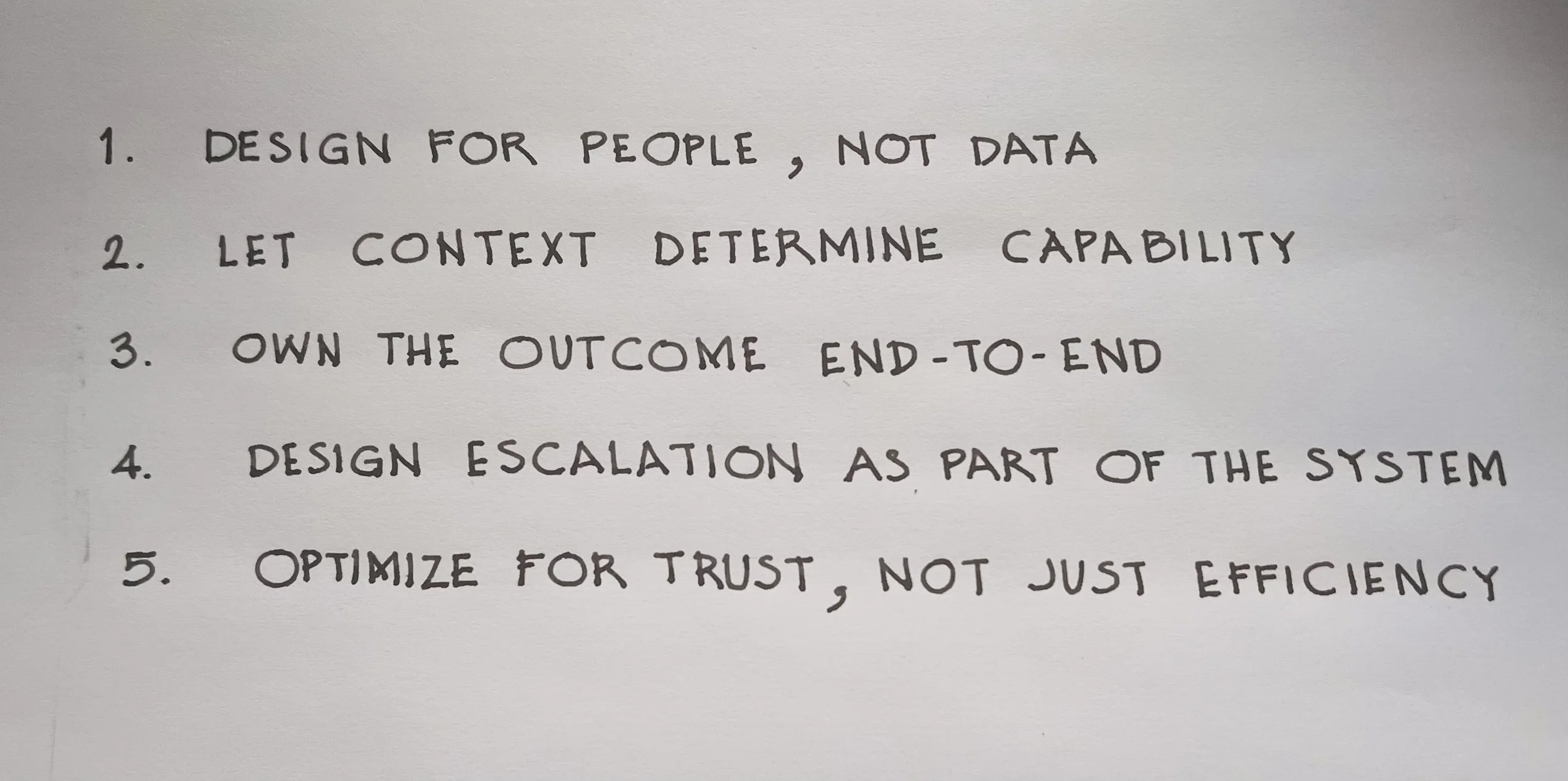
That's the pattern I kept seeing across every deployment. The technology worked. What wasn't designed for was everything around it — the moments it couldn't handle, the humans who had to pick up where it left off, the trust that eroded quietly when no one was watching. That's the layer most organizations aren't designing for. It's what I write about, and where I do my best work.
AI doesn't remove complexity.
It exposes it
One that knows experience isn't a function — it's how the whole thing works. Where the mission is clear, the right people are at the table, and what the customer — or employee, or partner — actually feels is how everyone knows if we got it right.
I'm looking for the organization that leads with experience
The Work
Every project begins with a reframe — the moment we understood what was actually being asked, and why the answer to the wrong question would not be enough. These are those stories.
─────
YOUTUBEDefined how YouTube NFL Sunday Ticket's support experience — powered by AI, backed by a human — would work
Concept to handoff in 4 months, ready before the NFL season opened
Designed for the customer — self-service where it served them, a human agent always available the moment they asked for one
Designed to scale, with new intents and products scoped at launch
─────
HPEDefined the product roadmap and launched the first app for HPE's global partner ecosystem — because partners who can see what's happening trust the system more, and sell more
Blueprint grounded in research with customers, partners, and employees, developed with 100+ senior HPE leaders
Adopted by the CEO as a reference for how HPE would compete
Led the launch of HPEGo — giving partners real-time order visibility for the first time
View Case Study →
────
MITSUBISHIThe brand Mitsubishi owners love. The website that finally showed everyone else why.
57% sales increase in three months, against a 6% industry average
Full experience available across every device, at a moment when the industry was still debating whether mobile deserved it
Build & Price rebuilt to connect what buyers wanted with what was actually available at their local dealer
View Case Study →
─────
ACCENTURERedesigned how a global firm listens to its most important relationships.
360 Listening —55 C-suite conversations, paired with the account teams on the other side of those same relationships
Findings presented directly to the CEO and global leadership team
The research became the foundation for Accenture's first dedicated client success function
*Email Anuradha.Sachdev for full case study

BUILDING THE PRACTICEThe practice that didn’t exist yet
Accenture Song — NA Customer Service Experience Lead | Managing Director · 2023–2025
The request came from Olof Schybergson — co-founder of Fjord and Chief Design Officer of Accenture at the time. He saw a gap: one of the largest service transformation businesses in the world had no experience design voice. Customer service was being reimagined by AI, and nobody in the room was asking what that should feel like for the people on the other end of it.
Building the practice meant starting with a team of designers who had never worked in customer service and weren't sure they wanted to. Their worry was reasonable — they were designers, not call center operators. The first job was to reframe what the work actually was: not call center design, but something more fundamental. The chance to make sure that when someone was frustrated, confused, or needed help for themselves or someone they loved, the support they needed was actually there. A quick answer when that was enough. A real person when it wasn't. And behind every one of those interactions, a call center operator — one of the hidden heroes of any service organization — whose job deserved to be made easier. That was the why. The AI was how we delivered it at scale.
There was a bigger reframe underneath that one. Customer service is usually treated as what happens when things break. But every time a customer calls frustrated, or a partner can't find what they need, or a patient is trying to navigate a system that wasn't designed for them — that's one of the most honest signals an organization can receive. It tells you what's actually broken, what needs to be corrected, and often where the next product or experience should come from. The best organizations don't just respond to those signals. They build from them. Customer service isn't a cost center. It's one of the deepest sources of insight available — if someone is actually listening.
Over two years the team moved from uncertainty to being among the first across Accenture to actively design and deploy agentic AI experiences in customer service. They learned conversation design. They built tools that went to market. They worked at the intersection of experience and technology in ways the broader organization was still figuring out.
At Accenture, promotions don't come from managers — they come from account leaders who nominate and rank the people who made their engagements better. Nine promotions from a team of fifty means nine account leaders, in competitive spaces, put their name behind these designers. That's not a metric. That's a measure of what the team became.
At Accenture you can be part of a team. You can be aligned to a group. What this became was something harder to build and rarer to find — a community. That's what I'm most proud of.
Built and led a multidisciplinary practice — from inception — working across design, strategy, technology, and operations, inside one of the world's largest professional services organizations.
Among the earliest teams at Accenture to design and deploy agentic AI in customer service — building tools that went to market and that both frontline employees and end customers actually used
Contributed to enterprise engagements at significant scale across technology, financial services, logistics, hospitality, and healthcare
9 of 50 team members promoted in 2025, nominated by account leaders across competitive client engagements
MORE OF THE WORKMeta · Cisco · T-Mobile · FedEx · Wells Fargo · Symetra Insurance · Kaiser Permanente · Geisinger · PG&E · Adobe · Toyota · Mitsubishi · AutoTrader · L'Oréal · Epson · State of New Mexico
Perspectives
April 2026
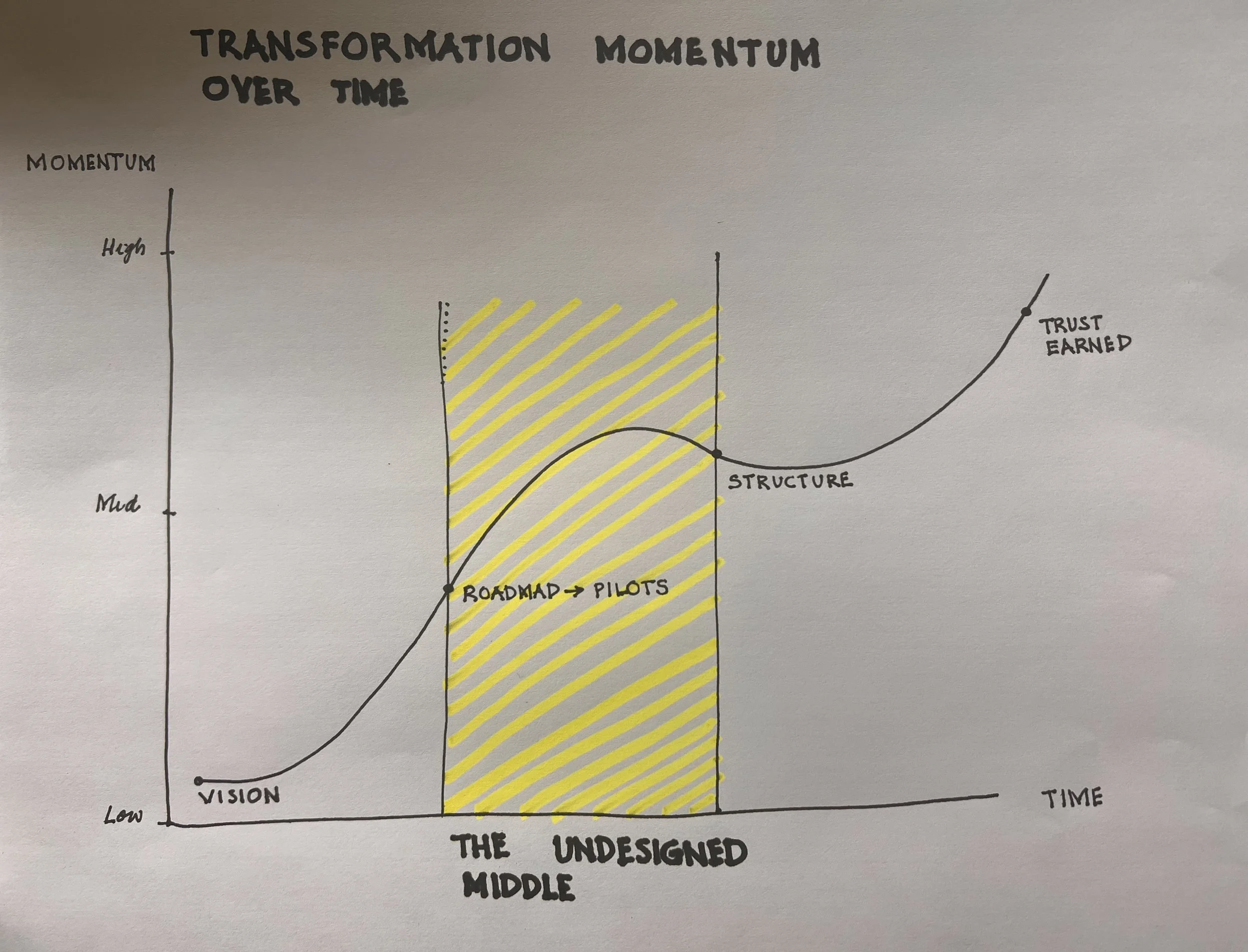
What happens in the space between AI and human — and why most organizations aren’t designing for it.
The Undesigned Middle
April 2026
When the real work begins — and what it asks of the teams and leaders responsible for it.
Read the article →