
April 2026
Nine experience principles that separate good companies from great ones — and why, for the first time, all of them are achievable.
Anuradha Sachdev built and led a fifty-person practice putting agentic AI into production at enterprise scale. This is what that work revealed.
Built for Every Person
IN BRIEF
The organizations that lead on customer experience grow revenue 41% faster and profit 49% faster than those that don't. ¹ Most leaders already know this.
The ambition has always been there — every organization has wanted to build for the customer in front of them. What's changed is that now it's actually possible.
Every leader navigating AI right now is holding the same tension. The pressure to show near-term returns is real. So is the imperative to transform.
Most organizations are using AI to do what they already did, faster and at lower cost. The ones pulling ahead are using it to do something that has never been possible before: build for every person. Not the majority. Not the average case. Design the system so it can adapt to each person rather than asking the person to adapt to the system.
These nine experience principles are how you build for every person.
A note before you start
These principles are drawn from a career leading customer experience transformation work — and most recently, from building one of the first teams to design and deploy agentic AI in customer service at enterprise scale.
The ambition to build for every person has always been there. What's changed is that the technology now matches it.
Before you start, three words worth defining. The person is whoever the system was built to serve — the customer, the patient, the partner. The system is everything built to serve them: the product, the process, the policy, the technology, and the employees who deliver it. The organization is everyone who decides what gets built, what gets measured, and what gets learned from.
These principles are organized in three clusters that follow that same structure. If you are coming to this fresh, start with The Undesigned Middle first.
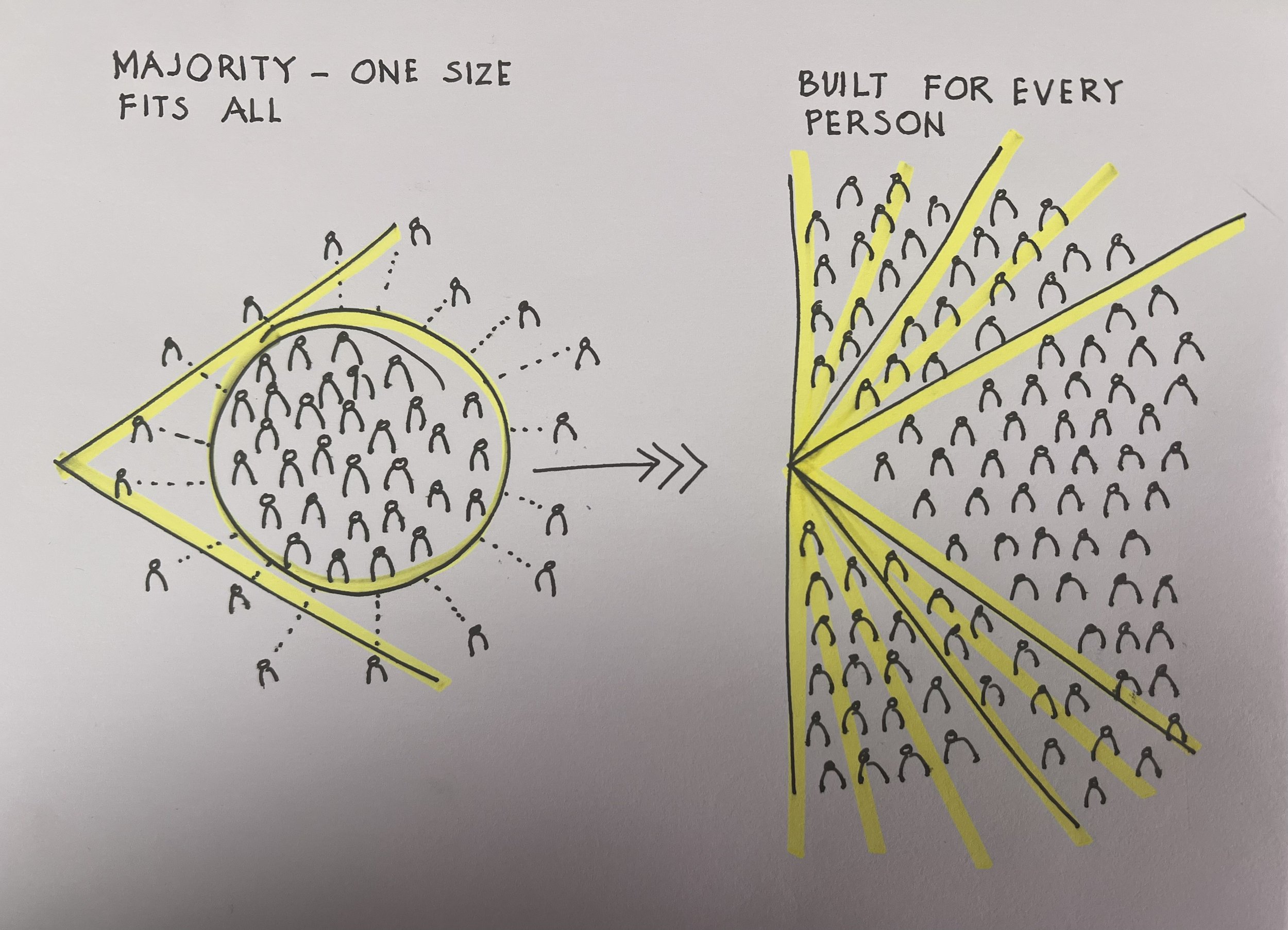
The ambition has always been there. Every organization has wanted to build for the person in front of them.
For the first time, it's actually possible. Not the majority. Not the average case. Every person.
THE NINE
Experience Principles
THE PERSON
Who you are building for — and what it costs them when the system gets it wrong.
1. See the person.
2. The person's time counts.
THE SYSTEM
Everything built to serve that person — the product, the process, the policy, the technology, and the people who deliver it.
3. Know your limits.
4. The process ends. The need does not.
5. Arrive ready.
6. Some moments need a person.
THE ORGANIZATION
Everyone who decides what gets built, what gets measured, and what gets learned from.
7. What gets measured improves.
8. What people do tells you more than what they say.
9. Own the whole.
PRINCIPLE 1
See the person.
The system worked. Just not for her.
When we redesigned the benefits portal for the State of New Mexico — used by more than half the state's population — the team had real ambition: one digital door, using what the state already knew about each resident to show them every benefit available to them. Then we met her. The woman who could not go to the child support office because doing so would reveal her location to an abusive partner. The team called it an edge case.
| Edge cases are humans too.
She needed something built to see her situation as it actually was. Each interaction can now be fluid and generative — built from what is true about this person, in this moment.
WHAT TO TEST AGAINST:
Have we designed for the person this system was least likely built for — or are we still treating them as exceptions to manage?
What does this system not know about the person in front of it that could change its response?
When the system gets it wrong, can the person it affects say so?
FAIL SIGNAL: The person said the information was wrong. The system proceeded anyway.
PRINCIPLE 2
The person's time counts.
Most systems are designed around what the organization needs to complete its process. The customer's time — what it costs them to provide it — never appears on any dashboard.
I had been with the same insurer for years, the kind of customer who pays the premium and hopes to never need it. When the LA fires damaged my roof, I filed my first claim in decades. It was denied. I paid out of pocket, then sent everything to update the policy. A week of silence, then pushback, then a threat to cancel. I was ready to walk away from a relationship I had trusted for years.
| The system that earns trust is the one that makes it easy to be your customer.
Every organization rolls out the red carpet for acquisition. Becoming a customer is fast and effortless. The moment that customer needs you is where the relationship is defined. A claim with photographic evidence can now be verified, approved, and closed. The companies that deliver at that moment earn customers for decades. The ones that don't will lose them faster than ever.
WHAT TO TEST AGAINST:
What is the system asking the customer for that it already has?
If the customer's time cost the organization money, what would we change?
Where are customers dropping off, switching channels, or giving up — and what does that tell us?
FAIL SIGNAL: The process asks for information the system already has.
PRINCIPLE 3
Know your limits.
What a system is built on determines what it gets right, and who it gets wrong.
In the early deployments of AI-assisted customer service, the systems were trained on resolved interactions — cases that had closed. They got good at recognizing those patterns. What they couldn't read was a second call that sounded routine but wasn't, or a customer whose tone signaled urgency the words didn't. The best customer service agents knew when to override the suggestion.
| A good system shows what it knows and where it's uncertain.
A system can be built to surface what it was trained on, flag where its confidence is strongest, and signal where to ask questions. More importantly, it can be built to watch, to track where it falls short in real use and route that signal back to the people who can close the gap. That is the standard: a system that keeps getting more whole.
WHAT TO TEST AGAINST:
Where is the system expressing certainty it hasn't earned?
Whose experience is in the data this was built on — and whose is assumed?
Can the person question what the system told them — or does the output feel final?
Where is the system falling short in real use — and who is responsible for closing that gap?
FAIL SIGNAL: The system expressed certainty where it should have asked a question.
PRINCIPLE 4
The process ends. The need does not.
The largest customers have always had someone in their corner. Dedicated teams, direct lines, answers before they ask. Everyone else has a portal.
We spent time with one of the world's largest technology companies asking all of their partners what the relationship actually felt like. The pattern held across the board: straightforward issues got resolved. But the question that mattered most — not how do I fix this, but how do I grow — sat entirely outside what the support model had been built to answer. For the smallest partners, the cost of getting there had outweighed the value of the answer.
Globally, small and medium-sized companies make up 90% of businesses, 70% of employment, and 50% of global GDP.² For the first time, every one of them can have a true partner — not just a portal.
| Most customers have never had someone whose job was to make them more successful.
That is now possible — for every customer, not just the largest ones.
WHAT TO TEST AGAINST:
Does this system serve all customers as well as it serves the largest?
Is this system designed to resolve requests, or to make customers more successful?
Does someone own the relationship after the interaction closes?
Are we measuring what changed for the customer, or just what closed for us?
FAIL SIGNAL: The customer's question was answered. Their situation didn't change.
PRINCIPLE 5
Arrive ready.
The information that would change a decision is almost always already there. The challenge is designing it to arrive before the moment.
The data director at a networking company came with a specific problem: his team had gone berserk building dashboards for every leader who asked. He needed to know what actually mattered. The move was obvious: go talk to the account managers and engineers doing the actual selling.
Three screens. Everything a salesperson needed came down to: their full universe of accounts, the health of a specific account, and the deal in front of them.
Account managers were running their own Excel spreadsheets to verify the data before they used it. If the sales number was wrong, nothing else got read.
The renewal insight went further. The default assumption was: renew the same. The data existed to ask whether something different would serve this customer better now. The system was built to close, not to advise.
| When the number is wrong, nothing else gets used.
The problem is rarely collection. It is almost always routing. Get the number right and the relationship stops being transactional.
WHAT TO TEST AGAINST:
What does the employee serving the customer not know, that exists somewhere in the organization?
What information does the organization capture that never reaches the moment it matters?
What should the employee be recommending to this customer that the system doesn't make easy?
FAIL SIGNAL: The right information existed. It didn't arrive in time.
PRINCIPLE 6
Some moments need a person.
Some customer interactions call for human judgment. The best organizations decide which ones before they build, and find the rest by watching where their team is already stepping in.
In a technical support queue at one of the world's largest telecommunications companies, a parent called in trying to locate a missing child. The queue was built for technical problems. This wasn't one. The agent stayed on, talking to the parent, coordinating with local authorities.
| The moments that reveal the most about a system are sometimes the ones it was never built for.
Every escalation that happens after hours, every fix that has become part of the job — that is the system showing you where an employee needs to be.
Customers don't always need an employee. But when they do, the employee needs to be there, with the context and authority to help. The balance between digital and employee is a design decision. It won't always be a customer; sometimes it will be their agent.
WHAT TO TEST AGAINST:
Which customer interactions require an employee, and did we decide that before we built?
Does the employee stepping in have the context and authority to actually help?
Who owns the balance between digital and employee, and is that balance being actively managed?
FAIL SIGNAL: The escalations kept coming. The design stayed the same.
PRINCIPLE 7
What gets measured improves.
The metrics you choose determine the organization you become.
When we mapped the partner experience for a global technology company, the gap was specific. When an order was delayed, the partner answering the phone knew as little as the customer calling to ask, which meant the people who were supposed to have answers didn't.
The solution was real-time visibility into every order. If a delay was coming, partners knew before their customers did. They could wait or find an alternative product.
| Most organizations measure a lot. Few can trace what they measure to what actually matters.³
When partners and customers have access to the same information at the same time, the partner stops being the person who has to apologize. They become the person who helps. And for the first time, the data exists to ask a harder question: do you need the intermediary at all?
WHAT TO TEST AGAINST:
Can we trace what we measure at the interaction level to what we care about at the business level?
Where are metrics improving while the experience is not?
What does success look like for the customer — and did we define that before we defined our metrics?
Which of our metrics connect to whether the customer's situation actually changed?
FAIL SIGNAL: Performance improved on every measure that was tracked. The experience didn't.
PRINCIPLE 8
What people do tells you more than what they say.
What most customers say is available to every organization. What their lives are actually asking for takes a different kind of listening.
A life insurance company came to us with a specific brief: help us build the most powerful product for customers who are younger, less economically stable, and who most of the industry had never designed for. What that listening revealed was simple: this generation didn't separate health from financial security. They were the same concern. The product built around that reality became the company's digital flagship and opened a market the industry had largely left untouched.
| Listening fixes what's broken. It also tells you what to build next.
The discipline is deciding that listening is not just for fixing what's broken. It tells you what to build next, who else to build it for, and where else to take it. The organizations that go look don't just find new products. They find new categories.
WHAT TO TEST AGAINST:
What are the people we serve showing us that we haven't acted on?
Who are we not yet reaching — and what would we learn if we went to them?
What are we designing from stated preference rather than observed behavior?
FAIL SIGNAL: The team kept designing from what customers said. What customers did told a different story.
PRINCIPLE 9
Own the whole.
For decades, when people were asked to name a company that got experience right, they said Apple. Every product. Every touchpoint. The whole.
A major telecommunications company made a public promise: no contracts, transparent pricing, customer first. Delivering it meant rebuilding how every interaction worked — at the store, online, on a call. The result changed what an entire industry was expected to be.
| Every touchpoint delivers against the promise.
Every part of the organization is getting smarter. Those returns are real. When every part serves the same customer experience, the organization compounds. The leaders going furthest are already asking what that looks like when the organization itself is rebuilt around it.
WHAT TO TEST AGAINST:
Are the improvements we're making in each function adding up to a better customer experience overall?
Who has been given explicit authority to close gaps that no single part of the business can close on its own?
Are we measuring what the customer experienced, or only what each part of the business delivered?
Who in this organization is responsible for what the experience looks like two years from now?
FAIL SIGNAL: A customer had to explain their situation again when they moved from one team to another.
THE IMPERATIVE
Where to start
If you run nothing else, ask these. One from each principle. The answer that makes the room go quiet is where the work begins.
Have we designed for the person this system was least likely built for — or are we still treating them as exceptions to manage?
If this person's time cost the organization money, what would we change?
Where is the system expressing certainty it hasn't earned?
Are we measuring what changed for the customer, or just what closed for us?
What does the employee serving the customer not know, that exists somewhere in the organization?
Who owns the balance between digital and employee, and is that balance being actively managed?
Who are we not yet reaching — and what would we learn if we went to them?
Can we trace what we measure at the interaction level to what we care about at the business level?
Who is responsible for the experience across the organization — not within one part of it?
Everything the best organizations have always wanted to build for their customers — they can build now.
1. Forrester Research. 2024 US Customer Experience Index. June 2024. Customer-obsessed organizations vs. non-customer-obsessed organizations across revenue growth, profit growth, and customer retention.
2. World Economic Forum. Driving Global Growth Through the Power of Small Business. January 2026. Small and medium-sized enterprises account for approximately 90% of all businesses, 70% of employment, and 50% of global GDP.
3. PwC. 2025 Customer Experience Survey. September 2025. Survey of 5,511 consumers and 406 executives in the United States. Nine in ten executives say customer loyalty has grown in recent years; four in ten consumers say the same.
I built and led the North America customer service experience practice at Accenture Song — fifty people designing and deploying agentic AI at enterprise scale. I came to this work through architecture and computation, which shaped how I think about systems: why organizations struggle to adapt, where trust is won or lost, and what it takes to make technology work in the real world. If that's the part you're building, I want to hear about it.
Email →