
May 2026
Every debate about AI and humans is actually three debates at once. Until you separate them, you can't answer any of them.
Anuradha Sachdev built and led a fifty-person practice that put agentic AI into production at enterprise scale by early 2024. This is what that work revealed.
What We Mean When We Say Human
A cognitive psychologist I know had an argument with her son. He's a VC. He'd built an AI agent to do research on companies he was considering funding — the kind of deep, time-consuming work that used to require a junior analyst with domain knowledge.
His mother told him he'd still need a human expert in the loop. He pushed back: domain experts bring their own bias. Their pattern recognition is shaped by what they've seen, what they've read, who they've worked with. Why assume that's better than the model?
It's the kind of question that doesn't resolve cleanly. Because it shouldn't.
What sounds like one question is actually three. And when you try to answer all three as one, you end up with a statement that any thoughtful person can immediately contradict, because the opposite is also true. The three questions are judgment, expertise, and accountability. They are not the same thing. Treating them as one is how this conversation always ends in stalemate.
ONE
Judgment
Judgment is not about incomplete information. It is about genuinely competing values.
A patient asks: should I take the experimental treatment? The data can tell you the survival odds. It cannot tell you what this person is carrying into that question — what they've already been through, what they're willing to go through again, what matters more to them than more time. That is a question the data was never designed to answer.
| Judgment without accountability is not judgment. It's computation.
TWO
Expertise
This is where the son's point lands hardest. And where he is most right.
In many domains, AI already outperforms human experts: more consistent, faster, less prone to the fatigue and distraction that shape human judgment on a bad day. The case for trusting the model over the specialist is not theoretical. In some settings it is the more reliable choice.
But there is a kind of expertise that works differently. An oncologist who knows not just that a good radiologist matters, but which specific radiologist to trust with a particular kind of scan — that knowledge lives in relationships, in reputation, in years of watching who catches what others miss. It has never been written down. It exists in no database. No model has been trained on it yet — not because the data doesn't exist, but because the knowledge was never in a form that could be captured.
| What you have seen shapes what you see. That is true of the radiologist. It is true of the model.
Most decisions about where to deploy AI get made before anyone has asked which kind of expertise is actually in the room.
THREE
Accountability
This is where the argument settles.
Who is responsible when the system gets it wrong? This is where the human is non-negotiable. Not because humans are better decision-makers. Because accountability requires a person. A system cannot be held responsible. A person must be.
I had been with the same insurer for years — the kind of customer who pays the premium and hopes to never need it. When the LA fires damaged my roof, I filed my first claim in decades. It was denied. I paid out of pocket, sent everything to update the policy. A week of silence, then pushback, then a threat to cancel. Nobody called. Nobody explained what had happened or what would happen next. I still do not know whether a person denied that claim or a system did. From where I was sitting there was no difference, and no way to find out.
| A system cannot be sorry. A system cannot make that right.
The organizations treating these failures as transition costs are building systems that will break in exactly the moments that matter most.
When something goes wrong — and it will — someone has to be able to look the person in the eye. That is not a process requirement. It is a human one.
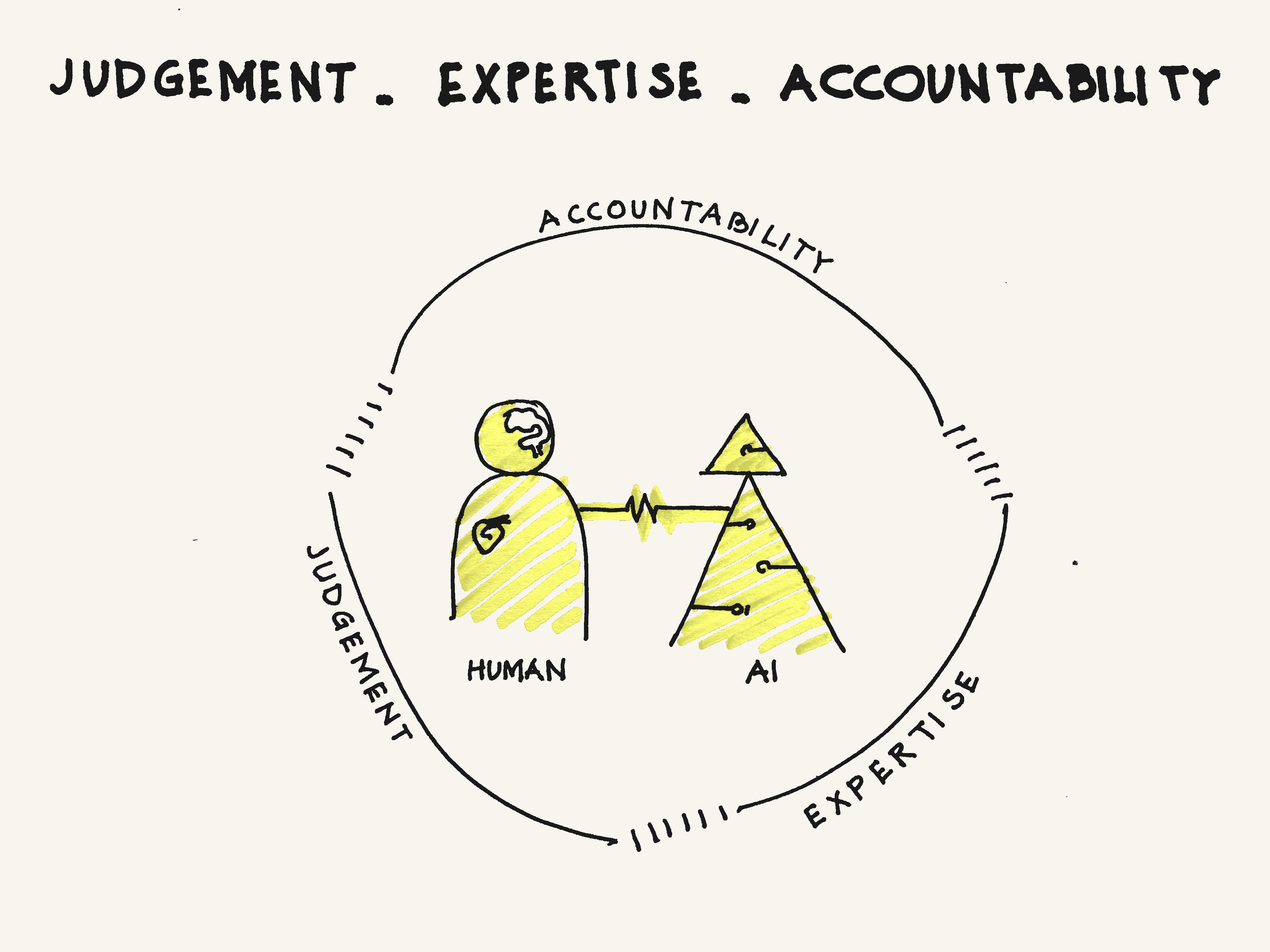
On expertise, the ground is shifting. Models are improving, human advantages are narrowing, and the honest answer in many domains is that AI is already the more reliable choice. On judgment, the question was never capability — it was whether a machine can hold competing values on behalf of a specific person in a specific moment. That remains genuinely open. On accountability, the question is simpler and harder at the same time: who answers for what the system did.
Judgment. Expertise. Accountability. They are not the same question. In most rooms, the first two get debated at length. The third gets assumed.
Anuradha Sachdev has spent her career redesigning how companies serve people through technological shifts — early digital, then mobile, now AI. Most recently she built and led the fifty-person practice at Accenture Song that put agentic AI into production by early 2024. She now works with companies, advising leadership teams, mapping what's actually happening and what to build next, or leading the product build through launch and adoption. She writes about what the work reveals.
Send a note →